


If a broadhead isn’t sharp enough to shave the hair off my arm, it isn’t ready to shoot at an animal. The KME Broadhead Sharpener makes that a reality.
Maybe it is just the cheap in me, but it just makes fiscal sense to resharpen broadheads if they have no dents or other abnormalities. I used to sharpen them by-gosh and by-golly holding the little blades in my hands using the scary sharp method. This method uses sandpaper on plates of glass and is most associated with woodworking, especially chisels and planes. If you’re interested in learning more an internet search for “scary sharp method” will return numerous helpful how-to’s. The problem is these middle-aged hands get cramped up after a little while and locking pliers just never seemed to work quite right.
Then on an archery forum I saw talk about the KME Broadhead Sharpener. I was intrigued. The concept worked well for my woodworking chisels. I thought it would work on my broadheads. I paid $34.95 for the basic sharpener plus $7.00 shipping and handling.
I’ve had good success with this sharpener on a variety of broadheads including little Wasp Jakhammer SST blades, Slick Trick blades and traditional style cut-on-contact two-blade broadheads. The sharpener will not work on traditional style fixed 3 and 4-blade broadheads (like a Wensel Woodsman).
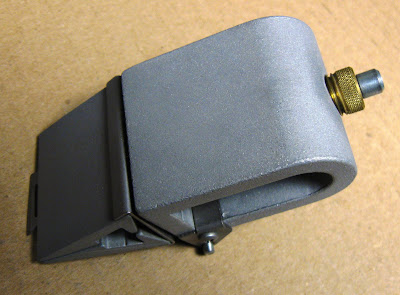
The KME Sharpener holding a Slick Trick broadhead blade. Note the brass-colored collar on the right.
Sharpening tiny Wasp Jakhammer blades.
.JPG)
Sharpening Slick Trick blades.
.JPG)
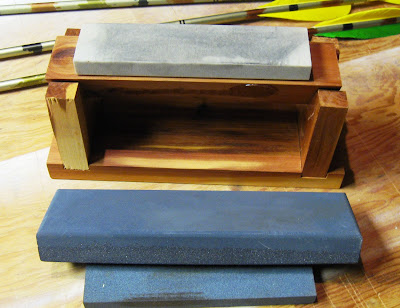
To use the sharpener, first determine which clamp to use. Then tighten down the clamp on the blade using the supplied wrench. Then insert the clamp stem into the roller guide and tighten down the collar. Now start sharpening. Based on the provided instructions I went back to my sharpening stones which I have plenty of. For this I use a silicon carbide combination medium/fine grit stone and an Arkansas fine stone. I follow the same sequence as when using a sharpening steel, see How To – Use A Sharpening Steel. Using the medium grit stone I’ll do five strokes on one side of the blade or broadhead and five on the other. Then four, then three, then two, then one. Then I switch to the fine side of the silicon carbide stone and repeat. Then on to the Arkansas fine stone using the same process.
An Arkansas fine stone on top (white), a combination fine/medium silicon carbide stone (gray, long) and a medium silicon carbide stone (bottom).
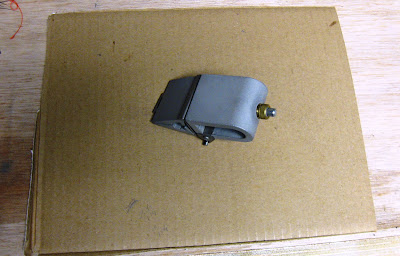
I used to finish them off with a ceramic sharpening steel, see How To – Use A Sharpening Steel, if necessary. However, since I ran into KME at the Madison, WI Deer and Turkey Classic, I learned an even better trick. Now I use corrugated fiber board following the same five, four, three, two, one method, except I pull the blade along instead of pushing it. Basically, this is a finely guided stropping method.
A final stropping on some corrugated fiber board. Note that the blade is being pulled from left to right versus being pushed from right to left.
Finally, I test the blade by attempting to cut the hair off my hand or arm. If it doesn’t then it is back to sharpening or off to the practice pile. I’m not successful with all blades, but am with most. If you are of the fairer sex with no hair on your arm, then I suggest saving some on your leg for the purpose. Just tell your significant other it is all in the name of bowhunting and ethical harvest. I suppose paper and rubber bands are suitable substitutes, but those analogs definitely lack commitment.
happy hunting, dv
If you liked this blog you may like the following:
- Packin It In And Out – Treestands
- Photographing Your Hunting Trophies
- JD Welding Arrow Spin Testing – A dv Gear Review
- Overhauling A Hunting Bow
- Archery Release Mystery Solved
- DIY $25 Bow Press
- Short Draw Bow Speeds And Technical Discussion
- Short Draw Bow Kinetic Energy And Trajectory
- DIY – Arrow Squaring Rig
- DIY – Solar Lighted Stabilizer
- How To – Use A Sharpening Steel
- Bow Stakes – “A Pointless Tip”
- Deer & Turkey Classic Review
Feedback, Questions & Comments
I’d like to hear your tips, feedback, comments or questions. Please leave them below.
Subscribe
Like this blog? Want to be notified of updates? Subscribe via RSS feed by clicking here.